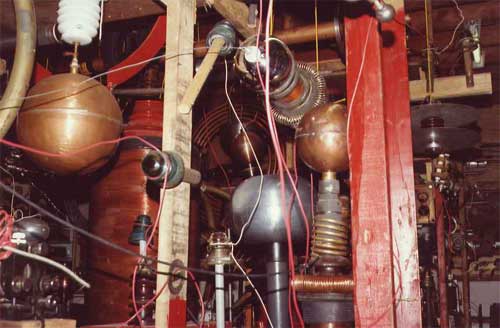
Hutchison's apparatus is best treated as a changing experimental environment, not a single reproducible machine. The ESJ apparatus article is the primary description currently in the archive. It describes a dense collection of high-voltage and RF devices, with diagrams and figure captions spread across the article.
Core components named in the archive
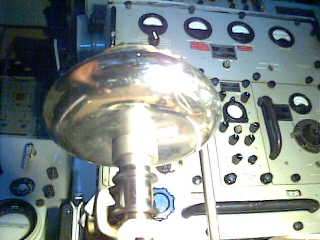
The apparatus article and extracted figure map identify a wide set of components: high-voltage AC transformers, a high-voltage DC X-ray transformer, RF/regen equipment, Tesla coil variants, vacuum-tube Tesla drives, Van de Graaff generator elements, a main toroid, alpha-beta flux units, a large transformer referred to in the research notes as "Big Red," spark-gap discharge hardware, an interferometer, monitors, receivers, and metal samples.
Source status: First-hand description. This establishes what Hutchison and ESJ described. It does not establish that the combined apparatus produced the claimed effects.
Power and frequency claims
The extracted research notes cite the ESJ article as describing source power around 110 V AC and roughly 400 to 4000 W, plus RF/regen equipment from about 450 kHz to 2500 MHz. Other ESJ-related notes describe a large Tesla coil, a smaller vacuum-tube Tesla coil, a Van de Graaff generator around 250 kV, and a 15-amp 110 V 60 Hz supply in Hathaway's narrative section.
These figures matter because many retellings portray the effect as a mystery caused by "low power." The source trail is more complicated: the system mixed high voltage, RF, spark gaps, large metal structures, and uncertain operating conditions.
Figure map from ESJ
| Figure | Caption in research notes | Page |
|---|---|---|
| 1 | Electrical Power Control | 2 |
| 2-3 | Dumbbell Tesla Coil and seven-foot Tesla Coil | 2 |
| 4-7 | Vacuum tube Tesla drive, Tesla Coil A/B, high-voltage DC insertion pulse unit | 3 |
| 9-12 | Main toroid and alpha-beta flux housing/setup | 4-5 |
| 13-14 | Modified brass ship antenna, receivers, and monitors | 6 |
| 15-16 | Aluminum, brass, and solid metal bars after the claimed effect | 7 |
| 17-18 | Interferometer and dual Van de Graaff generator arrangement | 8 |
Why apparatus detail is still not replication
A parts list does not define a reproducible protocol. The archive still lacks a controlled recipe for object placement, timing, tuning, environmental conditions, calibration, camera coverage, object custody, and failed-run logging. Without those, the apparatus can be historically documented but scientifically under-specified.
George Hathaway's 2009 MS&T conference paper adds a valuable participant account: he describes observing claimed events and analyzing samples, while also stating that he had not succeeded in making the phenomena repeatable or controllable. That tension belongs in the record; the paper is neither nothing nor an independent replication.
Working conclusion: the apparatus was real as an assemblage of high-voltage and RF equipment. The claimed anomalous effects remain unproven until the same system, or a specified equivalent, produces controlled and repeatable results.
Sources used on this page
The Hutchison Effect Apparatus, Electric Spacecraft Journal issue 8/9
First-hand apparatus description attributed to John Hutchison, with figures for coils, transformers, Van de Graaff devices, toroids, monitors, and metal samples.
Hutchison Effect Metal Samples: Description and Analysis, MS&T 2009
First-person account by longtime participant George Hathaway. It reports observations and sample analyses, but also says he was unable to make the phenomena repeatable or controllable; it is not an independent replication.
Cay Library ESJ #09 product metadata
Metadata for ESJ #09, published August 16, 1993, listing Hutchison Effect apparatus material and John Hutchison material.
The Hutchison Effect - A Lift and Disruption System
George D. Hathaway narrative describing Pharos Technologies, claimed propulsive and disruption categories, and early promotion of LADS.
Research page, hutchisoneffect.com
Research index containing PDFs and images, including sample photographs and ESJ material.
Electric Spacecraft Journal image gallery
Semi-official WordPress page showing ESJ page images; useful for provenance of republished scans.